
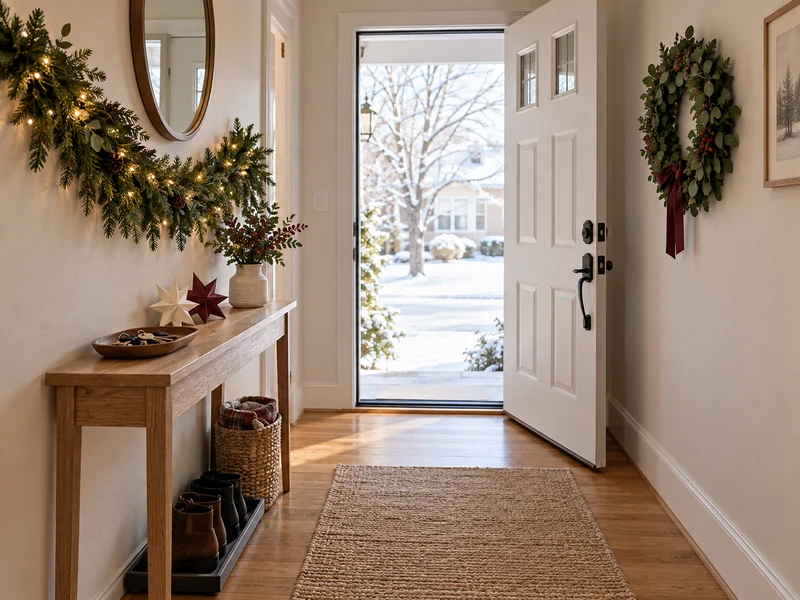
A small entryway can look festive without becoming an obstacle course. The most reliable approach is to decorate the wall first, keep the console display shallow, and give shoes and winter accessories one contained home below. That leaves the door swing, threshold, and everyday walking route doing the jobs they must do.
This plan is designed for a narrow entry with a working front door, not a styled corner that never has to handle groceries, coats, guests, pets, or wet boots. You will map the moving parts first, then build three compact decorating zones around them.
The Short Answer: Use Three Decorating Zones
- Wall zone: one wreath or a short run of greenery placed where it cannot catch the door, handle, coats, or bags.
- Slim surface zone: a restrained arrangement on a console, ledge, or wall shelf that stays clear of the walking route.
- Contained floor zone: a boot tray or one narrow basket pushed fully beneath the console or against a wall outside the door arc.
The empty space is part of the design. A visible strip of clear floor around the threshold and along the main route makes the greenery and warm lights feel intentional rather than crowded.
What You Need
- Tape measure, painter’s tape, pencil, and notepad
- One wreath or a manageable length of faux or fresh greenery
- Secure hanging hardware suited to the wall or door surface
- Battery-powered LED micro lights rated for the intended indoor use
- One shallow tray, vase, bowl, or pair of paper stars
- A boot tray or narrow basket for everyday items
- Reusable ties or soft floral wire for securing greenery
- Optional nonslip rug pad sized to remain completely beneath the runner
If you already have a console, measure its deepest point and the narrowest point of the passage. If you are buying one, a surface around 8–10 inches deep can be a useful starting range for some narrow entries, but it is not a universal rule. Your open door, required exit route, household needs, and local requirements determine what actually fits.
Step-by-Step Instructions
Step 1: Reset the entryway to its daily essentials
Remove decorative objects, extra shoes, loose mail, reusable bags, and seasonal items that have drifted into the entry. Put back only what the household genuinely needs at the door: perhaps a boot tray, a key dish, and one basket for gloves or scarves.
This is also the moment to solve the everyday layout. If keys, bags, shoes, and mail do not have defined homes, holiday decor will make the bottleneck more obvious. The 30-inch small-entryway drop-zone plan offers a compact foundation that can remain useful after Christmas.
Step 2: Map every door swing and the walking path
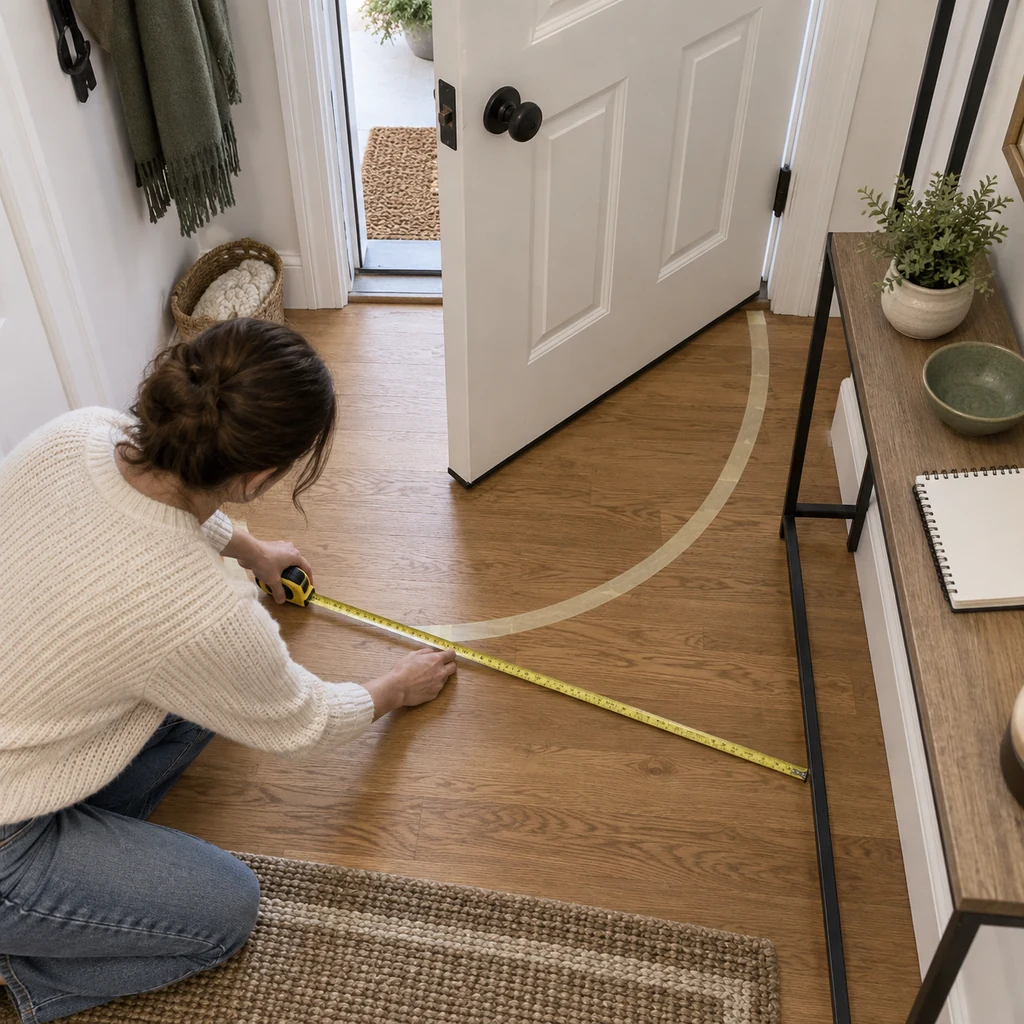
Open the front door through its complete normal range. Use painter’s tape to mark the arc on the floor, then repeat the test for a nearby closet, powder-room, or interior door. Mark the area needed to stand, turn, bring in parcels, and pass another person if the space normally handles two-way traffic.
Keep the threshold and any required exit route clear. Do not place a basket, tree, cord, loose greenery, or decorative sign behind a door where it can limit opening. Local building and fire-safety rules vary, so preserve the clearance your home requires rather than treating a decorative measurement as a code standard.
Step 3: Assign the wall, surface, and floor zones
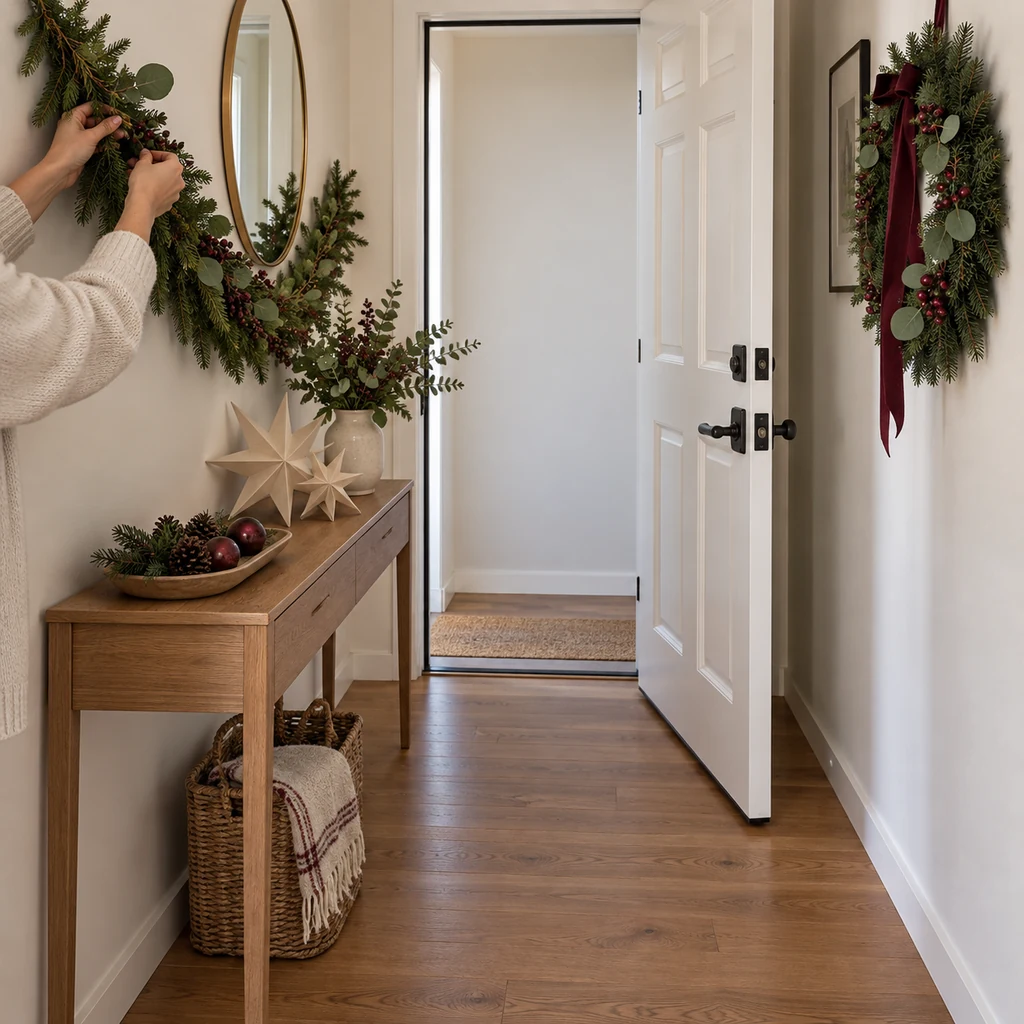
Choose one wall to carry most of the visual weight. A wreath, asymmetrical garland, or vertical greenery bundle uses height without taking floor space. Keep it away from hinges, locks, switches, thermostats, and the path of a shoulder bag carried through the doorway.
On the console, reserve one side for daily use and the other for a small seasonal arrangement. Below, use either a boot tray or one narrow basket; avoid several little containers that creep into the path. If a console makes the route feel tight even when empty, skip it and use a wall shelf or hooks instead.
Step 4: Choose one visual anchor
A narrow entry usually needs one dominant piece, not many medium-size pieces competing at eye level. Let the wreath, garland, or a pair of large folded-paper stars become the anchor. Repeat only two or three materials elsewhere—for example evergreen, warm wood, and burgundy ribbon—to make the small display feel cohesive.
Scale matters more than quantity. A wreath should sit securely within its available wall or door area without covering a peephole, lock, house number, or handle. Wall greenery should end before the door casing or corner where passing coats can snag it.
Step 5: Add lightweight depth without clutter
Layer one shallow bowl of pinecones or ornaments, a sturdy vase of clipped greenery, or two lightweight paper stars on the console. Keep breakables away from the edge and do not allow stems to project into the walking route. If children or pets use the entry, avoid small loose ornaments, glass, toxic plant materials, and decorations that can be pulled down.
Flat-folding decorations are particularly useful when storage is limited. The paper bag star tutorial shows how to make stars that open evenly and store flat after the season. Dried citrus can add warm color too; follow the drying and moisture-control steps in this dried orange and bay-leaf garland guide rather than hanging damp fruit in an enclosed entry.
Step 6: Add battery-powered light safely
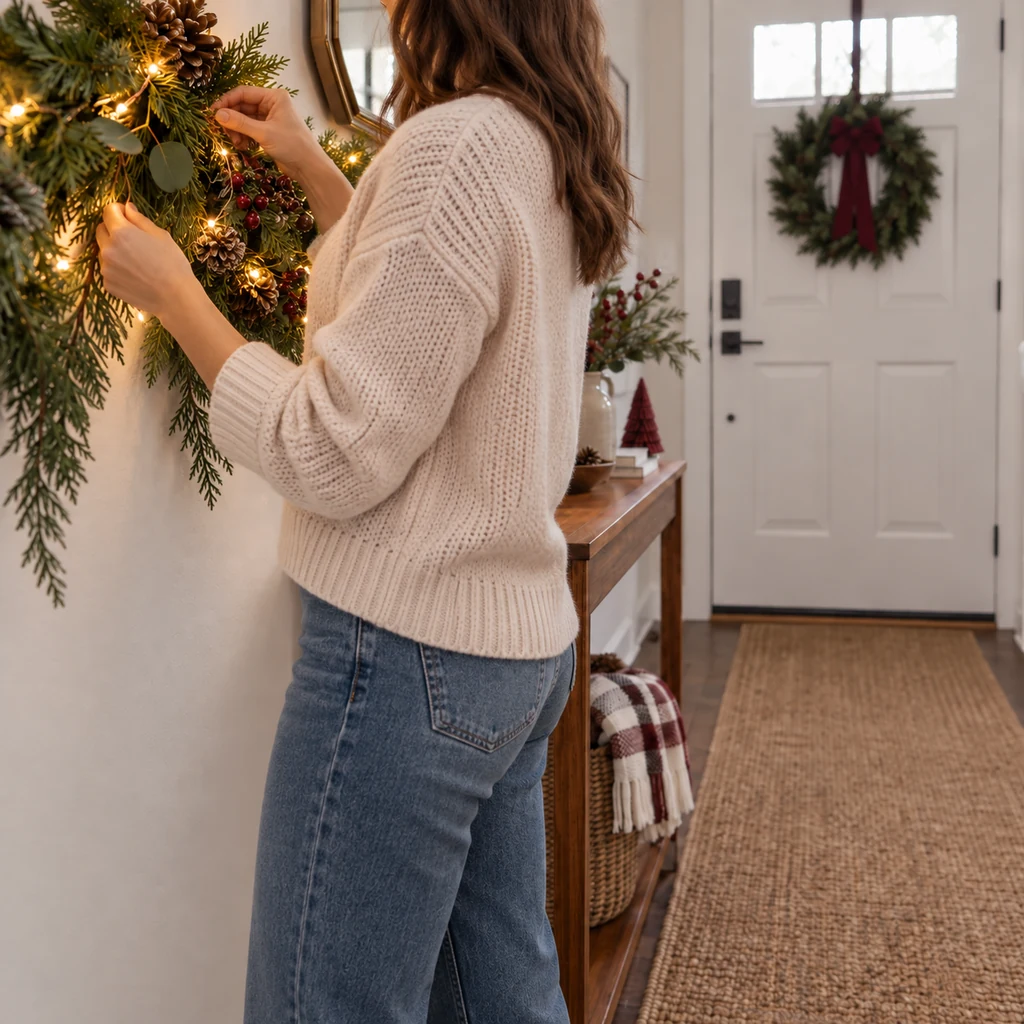
For a soft glow without a cord across the floor, use a short strand of battery-powered LED micro lights listed or certified for its intended use. Inspect the wire and battery compartment before installation, follow the manufacturer’s instructions, and do not combine mismatched batteries.
Weave the wire loosely through the greenery instead of crushing or sharply bending it. Secure the battery box beneath or behind the console, away from wet boots, curious pets, and the door mechanism, while keeping the switch accessible. Turn the lights off when appropriate under the product instructions. Never use real candles or an open flame near greenery, paper, ribbon, dried fruit, coats, or other combustible materials.
Step 7: Restore practical storage and test the route
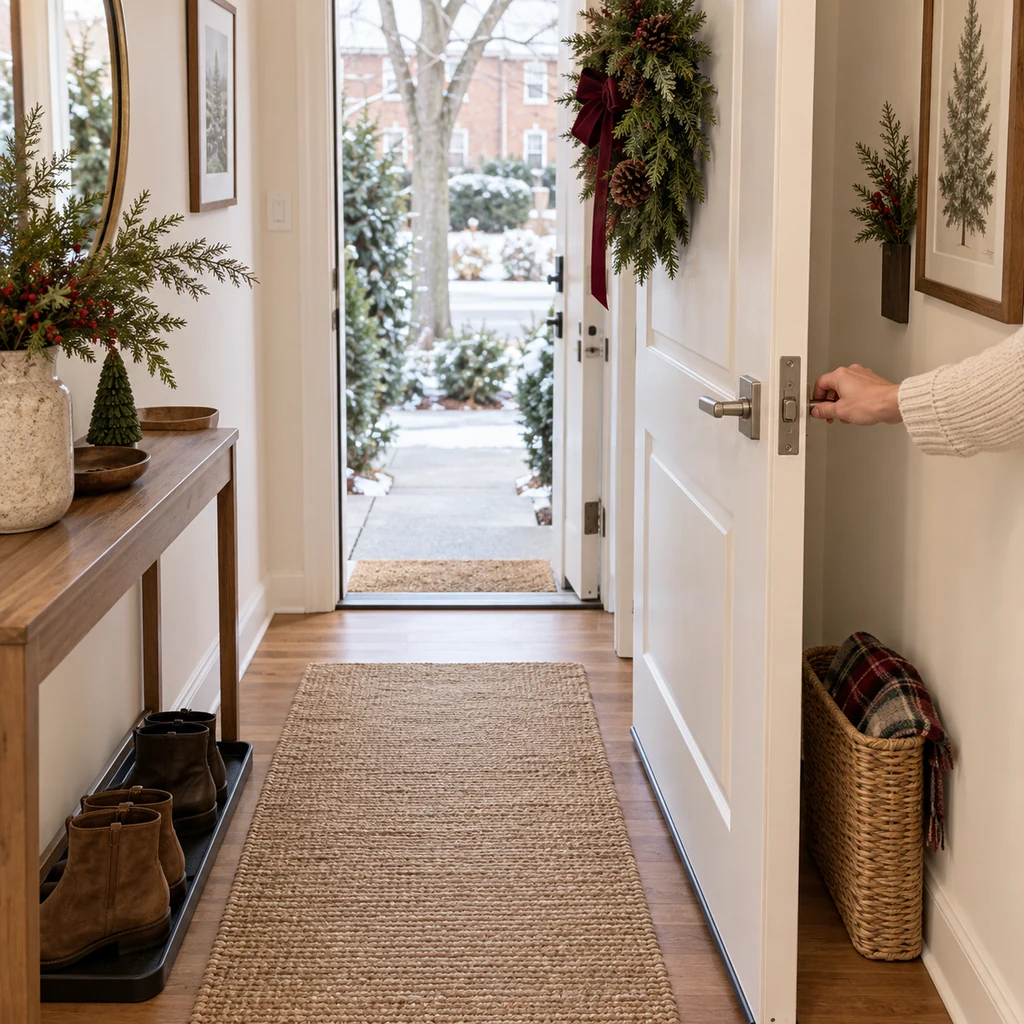
Return only the boot tray, basket, and daily accessories that fit completely inside their planned zones. A runner should lie flat with a suitable nonslip pad beneath it and should not bunch under any door. Electrical cords must never cross the floor or threshold.
Now carry a large bag or box through the entry, open every nearby door fully, and reach for the lock, handle, switches, and hooks. Nothing should brush your shoulder, catch the handle, narrow the threshold, or require a sideways step. If it does, remove an item rather than shifting it to another part of the path.
A Practical Small-Entryway Layout
Start with the door-swing arc as a permanent no-storage zone. Place a shallow console on the longest uninterrupted wall only if the remaining route feels comfortable in real use. Center the main greenery above that surface, keep the top display mostly below the mirror or artwork, and slide one boot tray underneath.
If there is no safe wall for a console, use a vertical wreath or greenery bundle, one high shelf for lightweight decor, and wall hooks positioned away from the moving door. Floor space is more valuable than another decorative object in a very tight entry.
Common Problems and Quick Fixes
The door hits the rug or basket
Remove the item from the arc rather than accepting partial opening. Choose a thinner, properly secured runner or move practical storage beneath a console outside the taped swing line.
The console looks crowded
Reduce the display to one tall element, one low element, and the daily-use tray. Varying height creates depth without covering every inch. Store the remaining decorations instead of transferring them to the floor.
The garland sags or catches coats
Add properly rated support points according to the hardware instructions and shorten any projecting branches. Do not rely on one hook for a long, heavy garland. When the wall finish cannot safely hold it, use a lighter faux strand or a single wreath.
The battery box is visible
Strap it beneath the back edge of the console or hide it behind a stable object while keeping the switch and battery compartment accessible. Do not bury it inside greenery or place it where moisture from boots can reach it.
Winter gear overwhelms the display
Limit the entry basket to the current rotation and move backups elsewhere. The five-zone small-closet system demonstrates the same useful principle: each category gets a boundary, and a full zone triggers editing rather than expansion.
Safety Checks Before You Finish
- The front door and every nearby door open through their complete normal range.
- The threshold, lock, handle, peephole, switches, and required exit route remain accessible.
- No cord, light wire, basket, branch, or rug edge crosses the walking path.
- Hanging hardware suits the surface and the decoration’s weight.
- Battery lights are intended for the location and used according to their instructions.
- There are no real flames near greenery, paper, ribbon, coats, or dried decor.
- Breakables, sharp pieces, button batteries, and small ornaments are inaccessible to children and pets.
- Wet footwear stays on a tray away from electrical components and finished wood.
Frequently Asked Questions
Can I hang a wreath on the inside of the front door?
Yes, if the hanging method suits the door and the wreath does not interfere with the frame, seal, peephole, lock, handle, or full opening. Test it by opening and closing the door slowly before normal use.
How deep should an entryway console be?
There is no universal depth. A slim piece around 8–10 inches deep may work in some narrow entries, but the correct choice depends on the door arc, the narrowest passage, accessibility needs, and local requirements. Tape the footprint on the floor and live with it for a day before buying.
How can I decorate without an outlet?
Use no-light greenery or a short set of battery-powered LEDs rated for indoor use. Secure the battery compartment off the floor, follow the manufacturer’s directions, and keep it accessible for switching and inspection.
Should I put a small Christmas tree in the entryway?
Only if it sits fully outside every door swing and required walking or exit route. In most truly narrow entries, wall greenery creates the same seasonal impact with less risk of tipping or crowding.
How do I keep a Christmas entryway tidy through the season?
Reset shoes and accessories each evening, clear mail immediately, and limit the console to one daily-use tray plus the seasonal arrangement. If a new item enters the floor zone, remove something else.
Final Five-Minute Check
- Open each door completely.
- Walk the route while carrying a large parcel.
- Check that the runner lies flat and all shoes are contained.
- Confirm that greenery and lights are secure and cool-running.
- Remove any object you have to dodge, move, or protect during ordinary use.
The best small entryway Christmas decor frames the arrival experience without interrupting it. Build upward, keep the surface edit tight, contain the practical items, and let the clear path provide the breathing room that makes the entire display look polished.