

A layered queen bed does not need nine decorative pillows. The practical formula is two sleeping pillows, two square Euro pillows, and one long lumbar—five pillows total. Add a coverlet, a folded duvet, and one throw for depth without turning bedtime into a cleanup project.
This guide uses cream as the main color, muted blue as the secondary color, and rust or camel as the small accent. Keep the arrangement and swap the palette to suit your room.
The Five-Pillow Formula at a Glance
| Row | Pillows | Useful size | Nighttime job |
|---|---|---|---|
| Back | 2 sleeping pillows | Standard 20 × 26 in or queen 20 × 30 in | Stay on the bed |
| Middle | 2 Euro pillows | About 26 × 26 in | Move to a basket or bench |
| Front | 1 lumbar pillow | About 14 × 36 or 16 × 36 in | Move with the Euros |
Pillow inserts and covers vary by brand. Measure your headboard and mattress before buying; the goal is for the two Euros to fill most of the queen-bed width without being crushed together.
What You Need
- Your normal fitted sheet and, if you use one, a top sheet
- One washable coverlet or lightweight quilt
- One duvet or comforter
- One throw blanket
- Two sleeping pillows in coordinated cases or shams
- Two Euro inserts and covers
- One long lumbar insert and cover
- One basket, storage bench, or clean shelf for the three decorative pillows at night
You do not need to buy every piece at once. Start with bedding you already use, then add the two Euros and lumbar only if the bed still looks visually flat.
How to Layer a Queen Bed Step by Step
Step 1 — Pick Three Colors Before You Add Layers
Choose one quiet main color for the largest surfaces, one secondary color for the coverlet and Euro pillows, and one small accent for the lumbar or throw. Repeating the secondary color once and the accent color once makes the bed look intentional without relying on a matched bedding set.
For the example bed, cream is the main color, slate blue is the secondary color, and rust plus a related camel neutral provide the small warm accent. If you prefer a simpler room, use two neighboring neutrals and one muted color.
Step 2 — Make the Functional Sleep Layer
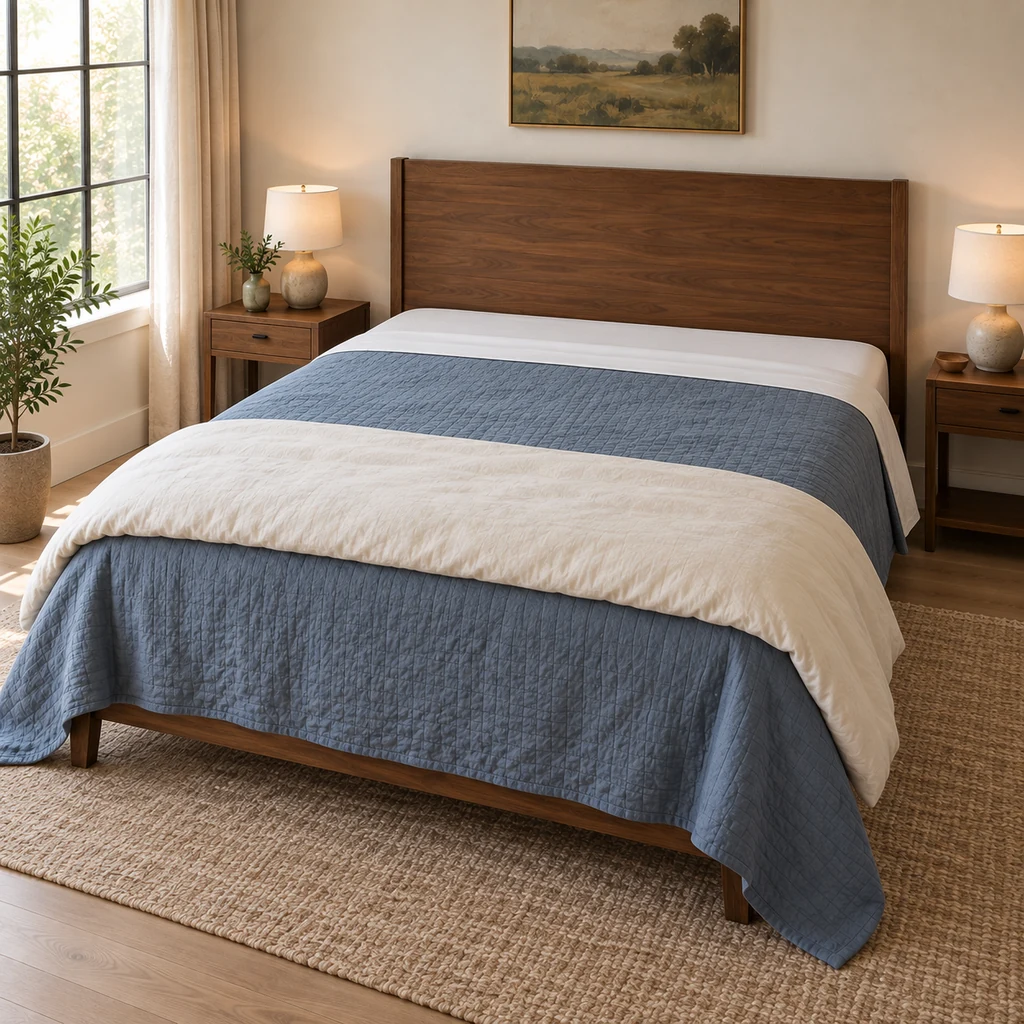
Fit the bottom sheet smoothly, working diagonally from corner to corner. Add the top sheet only if you normally sleep with one; styling should not force an extra layer you dislike. Pull it to the head of the bed and turn back a narrow band so the finished edge shows.
Keep the sleep layer comfortable for your climate. The visual depth comes from what is folded and exposed, not from stacking several heavy blankets on the sleeping area.
Step 3 — Add a Coverlet as the Color Base
Spread a lightweight coverlet or quilt over the bed and smooth it toward the sides. Let the drop look even on the left and right rather than trying to make every wrinkle disappear.
A solid or small-scale texture is easiest to reuse through different seasons. The coverlet supplies the secondary color and still looks finished if the duvet is removed during warm weather.
Step 4 — Fold the Duvet Across the Lower Third
Lay the duvet over the bed, then fold the top portion down toward the foot until it forms a broad, soft band across roughly the lower third to half of the mattress. A generous fold exposes the coverlet and makes the duvet look full without adding another insert.
Do not roll the duvet into a tight tube. Keep the fold broad and slightly relaxed so the corners drape naturally. If the insert slides inside the cover, secure the internal corner ties before styling.
Step 5 — Arrange the Five Pillows in Three Rows

Stand the two sleeping pillows against the headboard. Center two square Euro pillows in front of them, allowing a small amount of the sleeping-pillow corners to remain visible. Finish with one long lumbar centered across the front.
Stop there. One lumbar creates a clean focal point and replaces the usual row of small cushions. If your headboard is low, place the sleeping pillows flatter so the five-pillow arrangement does not hide it completely.
Step 6 — Add One Throw With an Easy Fold
Fold a throw lengthwise once and place it across the foot of the bed, or drape it over one lower corner. Choose one approach, not both. The throw should reveal the coverlet and duvet beneath it rather than covering the full bed.
Use the throw to introduce texture—wool, brushed cotton, or a soft knit—while keeping the color close to the lumbar or another small room accent.
Step 7 — Create a Three-Pillow Night Reset

Before bed, move the two Euros and lumbar into one dedicated basket, onto a storage bench, or onto a clean shelf. The two sleeping pillows stay in place. Keeping all three decorative pieces together prevents a floor pile and makes the morning reset a single trip.
Place the basket where it does not narrow a walkway or block a door. For more ways to give bedroom items a permanent home, use these clutter-free bedroom storage ideas.
How to Make the Layers Look Full, Not Fussy
Repeat Colors Instead of Matching Everything
Repeat the coverlet color on the Euro pillows, then echo the lumbar with the throw or one small room accent. Exact dye matches are unnecessary; nearby tones often look more collected than a complete set.
Mix Texture Before Pattern
If pattern mixing feels difficult, keep the large pieces solid and vary the texture: crisp sheet, stitched coverlet, soft duvet, and woven throw. Once that combination works, introduce a small stripe or subtle print on one removable cover.
Let Some Fabric Look Relaxed
Smooth the mattress corners and obvious bunches, but leave the duvet and throw slightly soft. Perfectly flattened layers can look thin; controlled folds create the depth people associate with a styled bed.
Common Bed-Styling Mistakes
- Buying pillows before measuring: two oversized Euros can crowd a low or narrow headboard.
- Using every color equally: let one quiet color cover most of the bed and reserve the strongest color for a smaller accent.
- Stacking heavy layers for appearance: use folds and texture to create depth without making the bed uncomfortably warm.
- Adding many small cushions: one long lumbar gives the front row a cleaner shape and is faster to remove.
- Ignoring nighttime storage: decide where the three decorative pillows will go before buying them.
- Hiding the headboard: lower or angle the back row if the pillows cover an important design feature.
Adapt the Formula to Other Bed Sizes
| Bed | Sleeping pillows | Euros | Front accent |
|---|---|---|---|
| Twin or Twin XL | 1 standard | 1 Euro | 1 small lumbar |
| Full | 2 standard | 2 Euros | 1 lumbar |
| Queen | 2 standard or queen | 2 Euros | 1 long lumbar |
| King | 2 king | 3 Euros | 1 long lumbar |
These are starting points, not rules. A wide headboard may support larger inserts; a compact room may look calmer with fewer. If you are simplifying the whole space, pair this bed formula with the restraint used in these minimalist bedroom ideas.
Seasonal Changes Without Rebuying the Bed
Keep the sheets, coverlet, duvet, and sleeping-pillow cases as the year-round core. Change only the lumbar cover and throw when you want a seasonal update. That limits storage needs and preserves the five-pillow routine.
For a light, natural variation, borrow the pale wood, soft textile, and low-clutter approach from this budget-friendly Scandinavian bedroom makeover.
Frequently Asked Questions
Do Euro pillows go in front of sleeping pillows?
They can. On a queen bed, placing two sleeping pillows against the headboard and two Euros in front creates a visible frame while keeping the arrangement easy to count. If you use your sleeping pillows for reading, reverse the rows during the day.
Are two Euro pillows enough for a queen bed?
Usually, two 26-inch Euros create a full middle row on a typical queen bed. Measure the usable width inside your bed frame or headboard before buying because inserts and frames vary.
Can I skip the top sheet?
Yes. Use the sleep layers you actually prefer. A fitted sheet, coverlet, and duvet can still create the same visual sequence.
What if I do not have room for a pillow basket?
Use a clean top shelf in the closet, the seat of a storage bench, or one designated side of a nearby chair. Avoid placing pillows where they block a walkway or collect dust on the floor.
How often should I change the decorative covers?
Follow each fabric’s care label and wash sooner after spills, pet contact, or visible soil. Removable, washable covers make the five-pillow formula easier to maintain than fixed decorative cushions.